
## **The Digital Revolution and Industry Industrialization in Portugal**

The construction sector in Portugal is going through a historic turning point. Pressed by the shortage of skilled labor, rising material costs, and growing sustainability requirements, the traditional industry — historically fragmented and analog — is giving way to a digital and industrialized ecosystem.

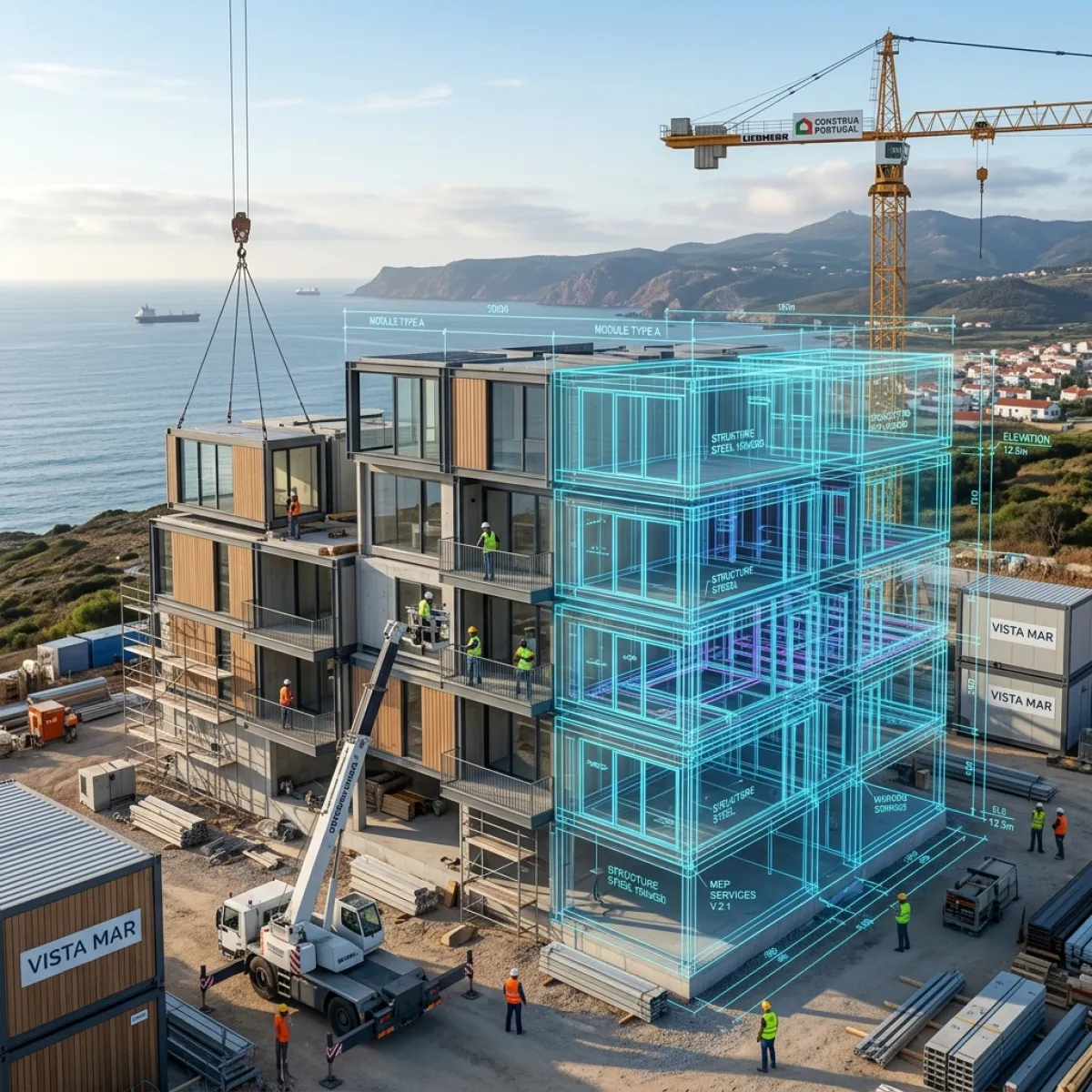
The convergence between **BIM (Building Information Modeling)** methodology, **off-site construction**, and **Artificial Intelligence (AI)** defines today who will lead the construction and real estate sector in the coming years.

## **1. BIM: Far Beyond 3D Drawing**

BIM is not a mere three-dimensional modeling software, but rather a collaborative process based on a **single source of truth** (SSOT). Through a shared virtual model, all stakeholders — architects, engineers, developers, and contractors — work on the same database in real-time.

The transformative value of BIM unfolds along its **seven dimensions**:

| Dimension | Main Focus | Practical Impact on the Worksite |
| :--- | :--- | :--- |
| **3D (Geometry)** | Spatial modeling | Automatic detection of conflicts (*clash detection*) between structure and specialties before excavation begins. |
| **4D (Time)** | Time planning | Sequential simulation of construction, optimizing the physical schedule and worksite logistics. |
| **5D (Cost)** | Financial control | Automatic extraction of quantity bills and dynamic budgeting associated with project changes. |
| **6D (Sustainability)** | Environmental performance | Lifecycle analysis, carbon footprint of materials, and energy efficiency of the building. |
| **7D (Facility Management)** | Operation & maintenance | Seamless transition from the executive model to asset management over decades. |

## **2. The Legal and Regulatory Framework in Portugal**

The trajectory of digitalization in Portugal is driven by a regulatory framework with well-defined targets:

### **Procurement and Public Works**

Under **European Directive 2014/24/EU** and the national public procurement strategy, the use of BIM methodology is designed to be **mandatory in all major public projects and contracts by 2030**. The State's objective is clear: to eliminate the usual financial slippages and missed deadlines in public works.

### **Private Sector and Urban Licensing**

In the private sector, the driver of adoption is the interoperability imposed by the modernization of licensing (**Simplex Urbanístico / Decree-Law no. 10/2024** and **Decree-Law no. 108/2026**). The transition to uniform digital submissions requires projects to be shared in open and universal formats (such as the **IFC** standard), making BIM an indispensable competitive advantage for those seeking swift approvals.

## **3. Off-Site Construction and DfMA: The Worksite as an Assembly Line**

Beyond software, innovation extends to the physical method of building. The answer to labor shortages and long deadlines lies in **Off-Site Construction** (industrialized) supported by the **DfMA (Design for Manufacture and Assembly)** philosophy — conceiving the project from day one with its factory production and fast onsite assembly in mind.

> **The concept of DfMA:** Transforms the worksite into a precision assembly process. Components are manufactured under strict quality control in a factory environment, immune to weather conditions, and transported to the site only for installation.

### **Highlighted Technological Systems in the Portuguese Market:**

* **LSF (Light Steel Framing):** Galvanized light steel structures with high thermal and acoustic performance, ideal for single-family housing and rapid rehabilitation.
* **CLT (Cross-Laminated Timber):** Cross-laminated timber that combines high structural strength with a negative carbon footprint, leading sustainable multi-story construction.
* **3D Modular Systems and Industrial Panels:** Fully finished modules in the factory (with bathrooms and kitchens pre-installed) or advanced facade panels, reducing execution time on site by up to **50%**.

## **4. Artificial Intelligence and Automation on the Construction Site**

Artificial Intelligence has left science fiction to become an operational tool on Portuguese construction sites:

* **Generative Design:** Algorithms that analyze thousands of implantation options in seconds, optimizing solar orientation, structural efficiency, and utility area utilization.
* **Computer Vision and Drones:** The processing of images collected by drones or fixed cameras allows automatically comparing the actual evolution of the worksite with the BIM 4D model, detecting schedule delays and safety non-compliances (Health and Safety at Work).
* **Predictive Risk Analysis:** Machine learning models that predict disruptions in the material supply chain or budget deviations before they occur.

## **Conclusion**

Portugal is at the turning point of civil construction. The combination of **BIM (from 3D to 7D dimensions)**, **Off-site/DfMA industrialization**, and **Artificial Intelligence** ceases to be a differentiator of innovation to become the operating standard of the market.

Companies and professionals who master this digital and industrialized matrix will ensure shorter deadlines, higher financial margins, and full compliance with the environmental requirements of the future.
Civil Construction
INNOVATIVE TECHNIQUES IN CIVIL CONSTRUCTION
By Joabson Bernardo