
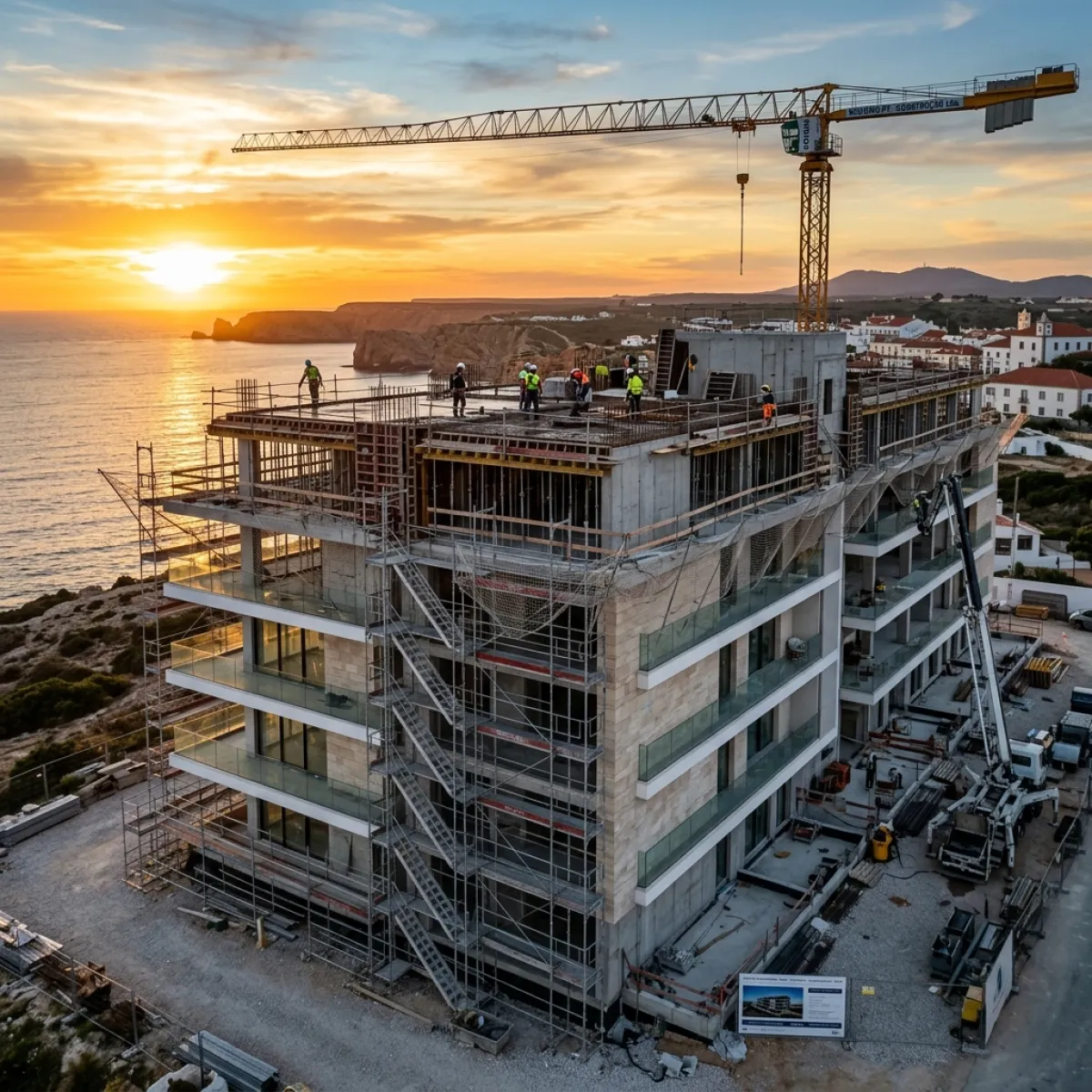
The Distortion Between Market Demand and Industry Response Capacity
Despite the investment prospects driven by European funds and real estate demand, civil construction in Portugal faces severe structural bottlenecks. The shortage of labor, the asymmetry between real costs and the purchasing power of the population, and fiscal complexity threaten project execution and company sustainability.
Without resolving these bottlenecks, the sector's growth potential will remain limited by production capacity constraints.
1. The Critical Shortage of Skilled Labor
The deficit of human resources is the greatest operational obstacle in the sector. Estimates from the Association of Civil Construction and Public Works Industrialists (AICCOPN) point to a shortage of over 80,000 professionals in all specialties — from bricklayers and carpenters to site managers and estimators.
Direct Impacts on the Market:
Slippage in Delivery Deadlines: Residential works and public tenders record average delays of 6 to 12 months due to the inability to scale teams on site.
Inflationary Pressure on Wages: The cost of direct labor has registered double-digit consecutive increases in recent years, impacting the operational margins of construction companies.
Dependence on Immigration and Need for Training: The integration of immigrant workers has been the main escape valve, but it requires an increased effort for technical training on site and prevention of occupational risks.
2. The Structural Housing Deficit
The imbalance between housing supply and demand has reached critical levels. To restore stock levels and respond to the creation of new households and immigration, it is estimated that Portugal needs to produce around 50,000 to 60,000 housing units per year. However, national production capacity has been fixed at around 20,000 to 30,000 homes annually.
This accumulated deficit over more than a decade has resulted in a continuous escalation of sales and rental prices, keeping the middle class and young people away from access to housing.
3. Real Cost Structure: Land, Materials, and Construction
There is a wrong public perception regarding the real cost of construction. The tax base value of €532/m² (fixed by ordinance only for tax assessment/IMI purposes) does not reflect the reality of the construction market.
Real Composition of Cost per Square Meter:
Real Cost of Construction (Contract): Currently varies between €1,200/m² and €2,200/m² for medium/standard quality housing, depending on location, technical specifications, and energy solutions.
Value of Land and Infrastructure: In the major metropolitan areas (Lisbon and Porto), the cost of consolidated urban land represents between 30% to 50% of the final value of the property.
Licensing, Projects, and Taxes: Costs of instruction, municipal fees, and financial charges during long approval periods significantly burden the final product.
4. The Impact of Fiscal Tax Burden and the Duality of VAT
The fiscal framework of the sector in Portugal is divided into two distinct regimes, with a strong impact on the economic viability of projects:
The sector's claim: Developers and builders argue that applying the reduced 6% VAT rate to new construction intended for affordable housing and long-term rental is the fastest measure to reduce the final price of houses for the middle class.
5. Work Accidents and Occupational Health and Safety (HST)
Civil construction remains the economic sector with the highest accident rate in Portugal, concentrating a significant percentage of serious and fatal work accidents monitored by the Authority for Working Conditions (ACT).
Persistent Risk Factors:
Pressured Deadlines: The attempt to compensate for accumulated delays sometimes leads to non-compliance with safety protocols in heights and excavations.
High Turnover and Chain Subcontracting: The multiplication of subcontracting levels makes continuous safety inspection on worksite difficult.
Lack of Qualification: The entry of new workers without prior training in Occupational Health and Safety increases operational risk.
6. Implementation Challenges in Municipal Licensing
Although the framework of the Urbanistic Simplex (DL no. 10/2024 and DL no. 108/2026) has created the legal basis to de-bureaucratize processes, practical application in the 308 Portuguese municipalities faces resistance and asymmetries:
Lack of Municipal Technical Resources: The shortage of architects and engineers in municipal staff delays the issuance of opinions and certificates.
Disparate Regulatory Interpretations: The absence of a 100% uniform application of national legislation by all municipalities creates legal uncertainty for investors with projects on a national scale.
Conclusion
Overcoming the structural problems of civil construction in Portugal requires coordinated action between the State and private initiative. The answer lies inevitably in industrializing construction (to reduce dependence on labor-intensive work), reforming taxation on new housing, and ensuring total digital uniformization of urban licensing.